🩺 Clinical Summary: First 2000 Days of Nutrition
-
âś“
Key Finding: Improving nutrition across the first 2000 days requires coordinated action across families, healthcare services, childcare settings and food environments.
-
âś“
Evidence: This rapid review synthesized evidence from 60 systematic reviews and selected grey literature reports on nutrition and food sustainability from conception to five years of age.
-
âś“
Practice Tip: Support breastfeeding, strengthen complementary feeding practices and guide families toward healthy diets in early childhood, while recognizing the role of the food environment.
The first 2000 days of life, from conception to a child’s fifth birthday, represent a critical window for shaping long-term health, development and dietary patterns. Early life nutrition during this period influences growth, diet quality and the risk of overweight and obesity later in life.
This rapid review evaluated what works to improve first 2000 days nutrition and food sustainability using a food-systems framework. The authors reviewed evidence across caregiver behaviors, personal food environments, external food environments and broader food-system determinants.

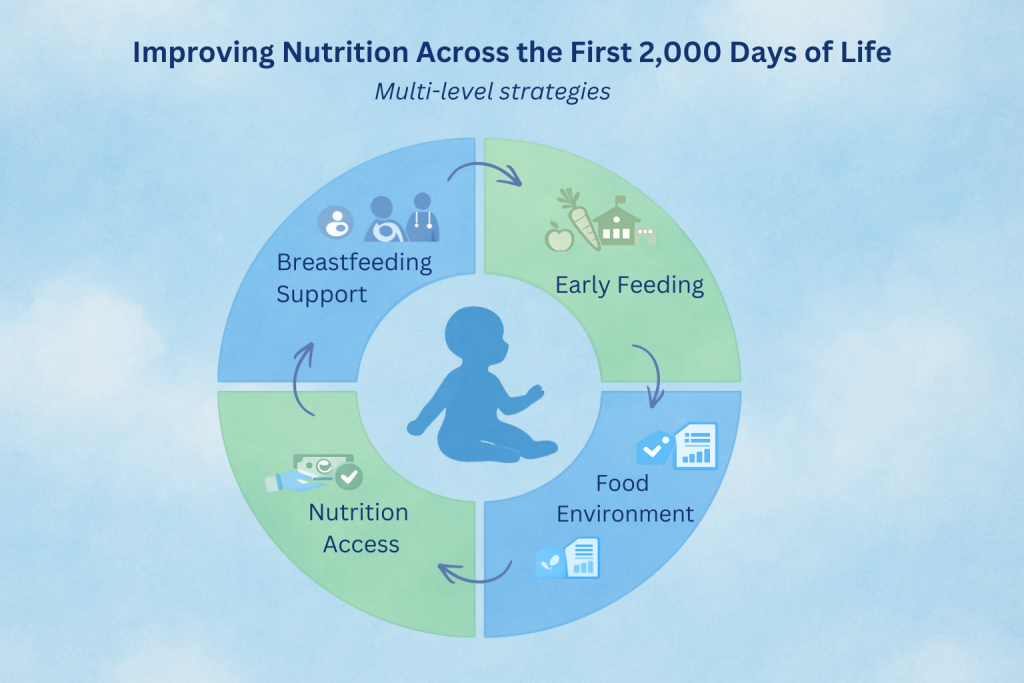
Multi-level strategies supporting nutrition during the First 2,000 Days of Life
Key Clinical Insights on Early Life Nutrition
Most available evidence focused on interventions targeting parents, caregivers and children, particularly breastfeeding interventions. Fewer reviews addressed personal or external food environments, and no systematic reviews focused specifically on food supply-chain activities, highlighting an important gap in the evidence base.
Overall, the findings suggest that improving infant and young child nutrition requires multi-level strategies combining education, practical support and healthier environments where children live, eat and learn.
Breastfeeding, Complementary Feeding and Parent Education
The review supports multi-component breastfeeding interventions, especially those combining education, counselling, peer support and health professional involvement across antenatal and postnatal care.
For parent-focused child nutrition interventions, evidence was more mixed. However, approaches that actively engage parents through practical skill-building appear more effective than passive information alone. Responsive feeding education, clear nutrition messages and repeated exposure to vegetables may help improve complementary feeding practices and support healthier food preferences.
Early childhood education and care settings were also identified as important spaces for reinforcing healthy diets in early childhood.
Food Systems Approach to Child Nutrition
The review emphasizes that child nutrition is shaped not only by caregiver knowledge, but also by access, affordability, availability, food marketing, labelling and retail environments. A food systems approach to child nutrition is therefore needed to support healthier choices.
Food vouchers, community gardens, local food initiatives and improved access to healthier foods may help support families experiencing disadvantage. Broader food environment strategies, including marketing restrictions, fiscal policies and improved food labelling, may also contribute to healthier dietary patterns and childhood obesity prevention.
Implications for Infant and Young Child Nutrition
This review reinforces that optimizing nutrition during the first 2000 days requires coordinated support beyond individual counselling alone.
In practice, healthcare professionals should:
- Reinforce the importance of nutrition during the first 2000 days
- Support breastfeeding through consistent, evidence-based counselling
- Guide families on responsive feeding and healthy complementary feeding practices
- Encourage repeated exposure to vegetables and healthy foods
- Recognize how food environment and child nutrition are closely connected
Overall, improving first 2000 days nutrition requires action across clinical, childcare, community and policy levels. These multi-level strategies can help support healthy diets in early childhood and contribute to better long-term health outcomes.
Access the full publication:Â https://doi.org/10.3390/nu14040731
Source
Nutrients, 2022Â
Laws R. et al.Â
DOI: 10.3390/nu14040731