
🩺 Clinical Summary
- ✓ Key Finding: Reflux-related symptoms and I-GERQ-R scores decrease with age in healthy infants.
- ✓ Evidence: In 979 healthy infants aged 0-24 months, the median I-GERQ-R score was 6, with scores declining significantly as age increased.
- ✓ Practice Tip: Interpret infant reflux score results within an age-specific clinical context; a score ≥16 should not automatically indicate GERD in young infants.
Gastroesophageal reflux in infants is common and often overlaps with normal developmental behaviors. Symptoms such as infant regurgitation, crying, irritability and feeding-related discomfort may raise concern for GERD symptoms in infants, but these features are also frequently reported in otherwise healthy infants.
The Infant Gastroesophageal Reflux Questionnaire Revised (I-GERQ-R) is used in infant reflux assessment to score reflux-related symptoms, including regurgitation, irritability and crying. However, previously suggested cut-off values, including an I-GERQ-R score of ≥16, did not account for reflux symptoms by age.
This study aimed to establish age-dependent normal values for the I-GERQ-R in healthy infants aged 0-24 months, to support more accurate clinical interpretation of reflux-related symptoms.
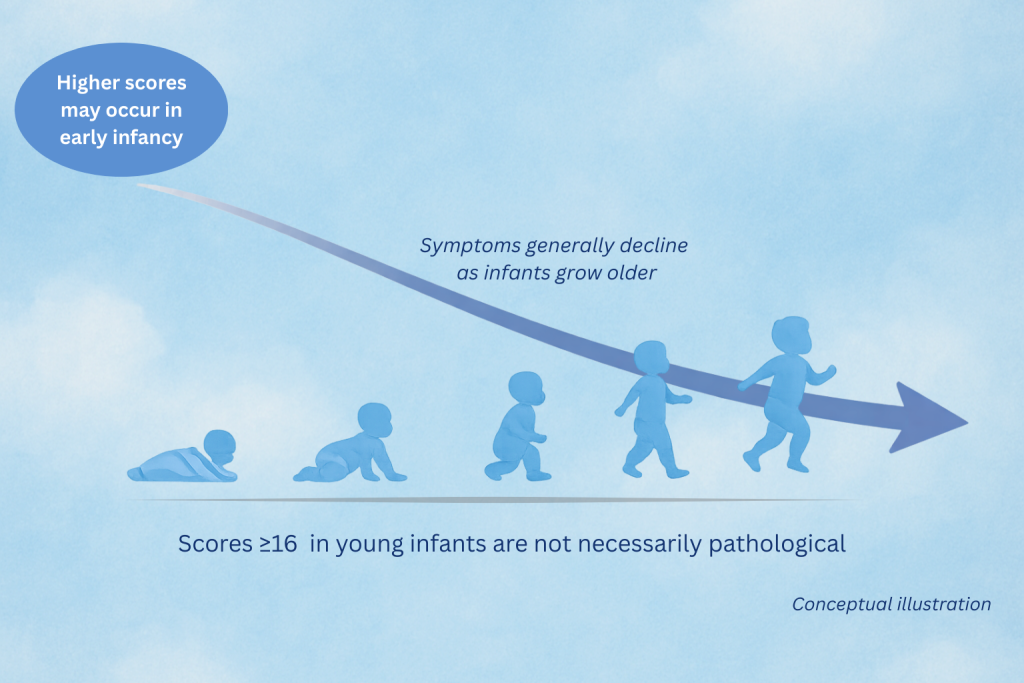
Conceptual illustration of gastroesophageal reflux-related symptoms in relation to growth and scores.
Key Clinical Insights on I-GERQ-R Score
This cross-sectional study included 979 healthy infants. The median I-GERQ-R score was 6, and scores decreased significantly with age, supporting the concept that reflux symptoms follow a clear age-related pattern.
Overall, 5% of healthy infants had an I-GERQ-R score ≥16, a threshold previously considered suggestive of GERD. Higher scores were most frequently observed in early infancy, reaching 16% in infants aged 0-1 month, and largely disappeared after 15-16 months of age.
The elevated scores in younger infants were mainly driven by the high prevalence of infant regurgitation, colic-associated symptoms and hiccups, all of which declined over time.
Reflux Symptoms by Age in Healthy Infants
Age-related symptom patterns were mainly driven by changes in regurgitation, crying-related symptoms and hiccup frequency.
Infant regurgitation was highly prevalent during the first months of life, occurring in 70-79% of infants during the first 6 months, before declining markedly thereafter. Crying symptoms decreased earlier than regurgitation, with more than half of infants aged 4 months and older reported to cry for less than 10 minutes per day.
Overall, reflux-like symptoms declined mainly during the first year of life and approached near resolution in most infants after 12 months. These findings reinforce the physiological and self-limiting nature of many reflux-like symptoms in early infancy.
GER vs GERD in Infants: Clinical Interpretation of Reflux Scores
The findings highlight the importance of distinguishing physiological reflux in infants from gastroesophageal reflux disease. A higher infant reflux score may reflect normal age-related symptoms rather than disease, particularly in the first months of life.
Importantly, the authors emphasize that age-dependent normal values should not be interpreted as diagnostic cut-off values. Further validation is needed before the I-GERQ-R can be used as a diagnostic tool to distinguish GER vs GERD in infants.
These results support a cautious interpretation of reflux questionnaires in clinical practice. Pediatric GERD diagnosis should not rely on questionnaire scores alone, especially when symptoms are common, mild and age-appropriate.
Implications for Pediatric GERD Diagnosis
This study provides practical guidance for healthcare professionals involved in infant reflux assessment.
In clinical practice, healthcare professionals should:
- Recognize that infant regurgitation and reflux-like symptoms are frequently physiological
- Interpret I-GERQ-R score results according to infant age
- Distinguish physiological reflux in infants from clinically significant GERD
- Use reflux questionnaires as supportive tools, not stand-alone diagnostic instruments
- Consider broader clinical features, including symptom severity, feeding difficulties, growth concerns and red flags
Overall, these findings support an age-sensitive approach to infant reflux assessment. Age-dependent reflux questionnaire scores in infants may help reduce overinterpretation of GERD symptoms in infants and support more appropriate clinical decision-making.
Access the full publication: https://doi.org/10.1007/s00431-023-05281-w
Source
European Journal of Pediatrics, 2024
van Lennep M. et al.
DOI: 10.1007/s00431-023-05281-w