
The period from conception to five years of age, the first 2,000 days, represents a critical developmental window during which nutrition plays a foundational role in shaping long-term health trajectories. Dietary patterns established during this stage influence growth, immune function, neurodevelopment and future risk of non-communicable diseases.
This rapid review evaluated evidence on effective strategies to improve nutrition and food sustainability across early childhood, applying a food-systems framework to identify interventions at multiple levels.
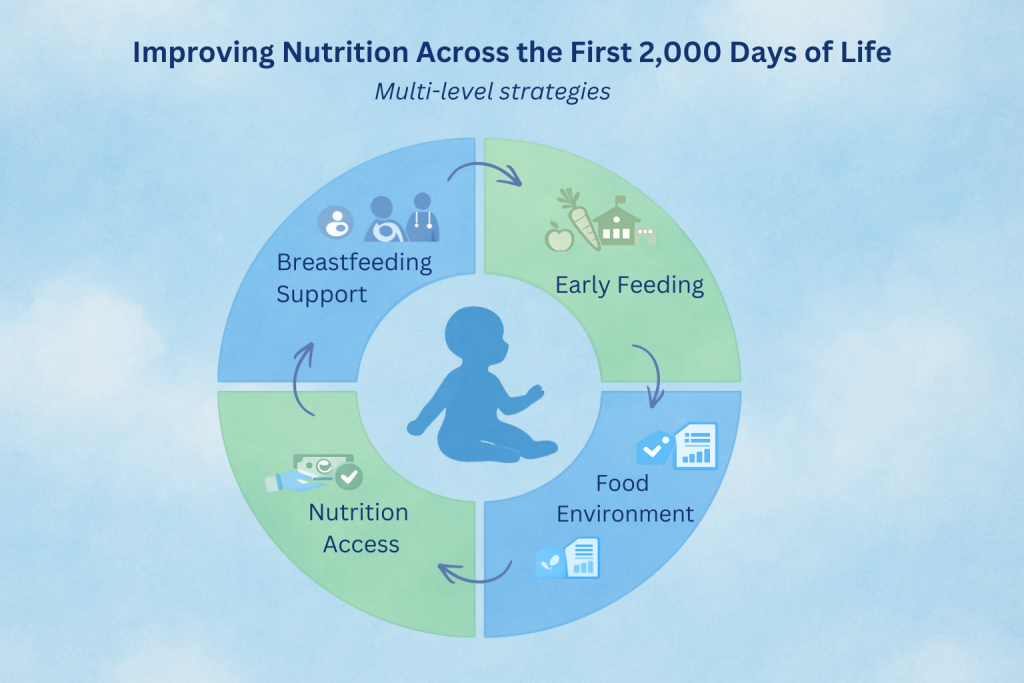
Multi-level strategies supporting nutrition during the First 2,000 Days of Life
Key Clinical and Public Health Insights
Drawing on 60 systematic reviews and 23 grey literature reports, the strongest evidence supports multi-level, coordinated interventions beginning early in life.
1. Breastfeeding support
- Multi-component programs combining education, professional counselling, and peer support improve breastfeeding initiation, duration, and exclusivity.
- Continuity of care from antenatal to postnatal periods and early skin-to-skin contact enhance outcomes.
2. Early feeding practices
- Parent-focused interventions are more effective when interactive, theory-informed, and centred on responsive feeding.
- Repeated exposure to vegetables improves acceptance and supports healthier dietary patterns in early childhood.
3. Healthy growth and nutritional adequacy
- Targeted supplementation and voucher programs improve nutritional status in vulnerable populations, particularly in children under two years.
4. Policy and food environment measures
- Fiscal strategies (e.g., sugar-sweetened beverage taxation, healthy food subsidies), marketing restrictions, and front-of-pack labelling positively influence dietary behaviours.
- Structural policy interventions may contribute to reducing long-term health inequities.
Importantly, the review highlights that sustained improvements in early-life nutrition require alignment across healthcare, childcare settings, community programs, and food systems.
Implications for Clinical Practice and Policy
The evidence reinforces that optimizing nutrition during the first 2,000 days requires coordinated support beyond individual counselling alone. Healthcare professionals play a central role by:
- Supporting breastfeeding through evidence-based guidance
- Promoting responsive feeding and healthy complementary feeding practices
- Recognizing early childhood as a key period for establishing lifelong dietary behaviours
- Understanding how broader food environments influence family feeding choices
Overall, the findings underscore that early-life nutrition interventions, when implemented across clinical, community and policy levels, provide a foundation for healthy growth, immune resilience, and long-term disease prevention.
Access the full publication: https://doi.org/10.3390/nu14040731
Source
Nutrients, 2022
Laws R. et al.
DOI: 10.3390/nu14040731